
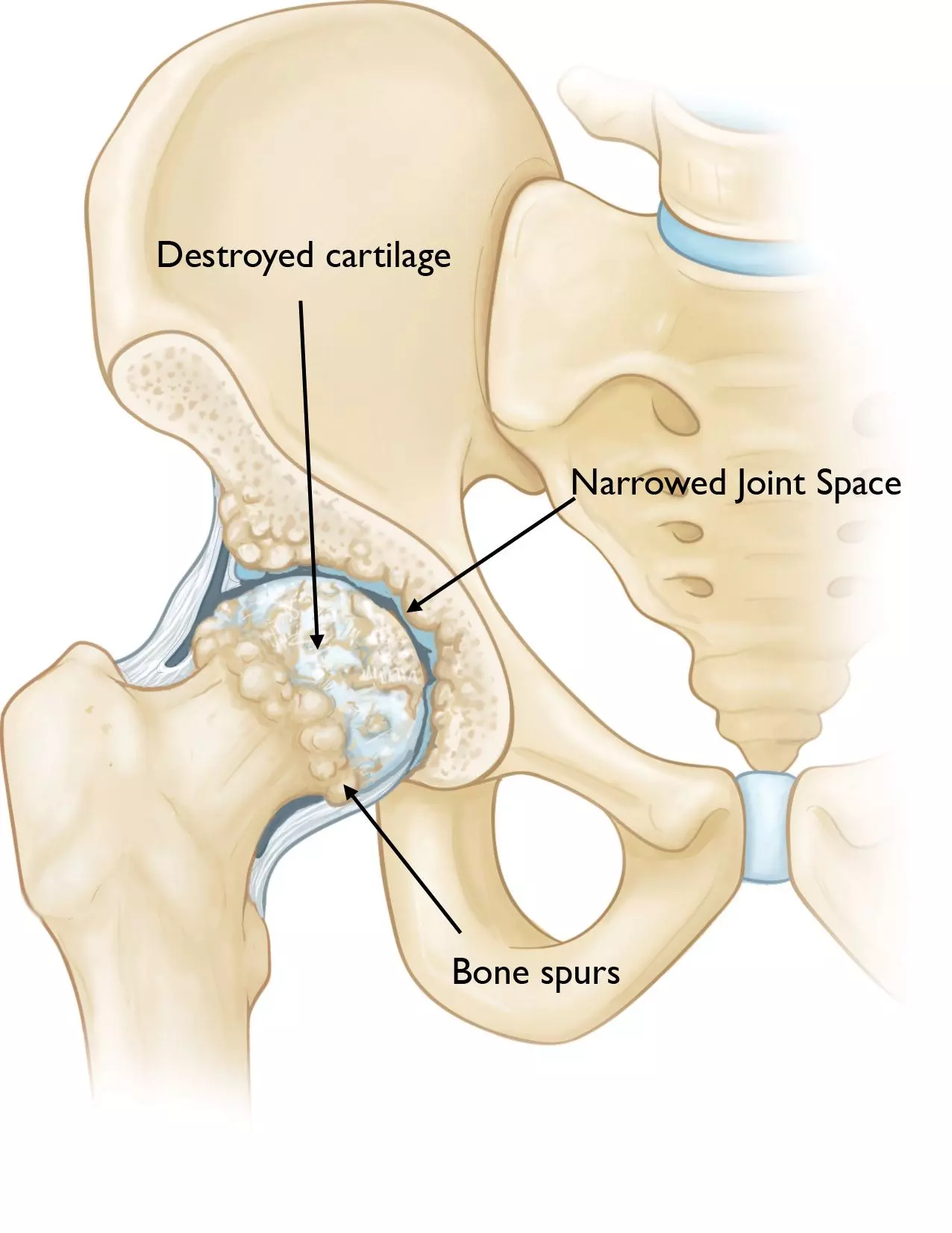
What is Hip Arthritis?
Hip Arthritis means joint inflammation which causes pain and swelling in the body’s joints such as in the knees or hips. There are many types of arthritis, but Osteoarthritis is the most common. Also known as Degenerative Joint Disease or Age-related Arthritis, Osteoarthritis is more likely to develop as people get older. Osteoarthritis occurs when inflammation and injury to a joint cause a breaking down of cartilage tissue. In turn, that breakdown causes pain, swelling, and deformity.
Cartilage is a firm, rubbery material that covers the ends of bones in normal joints. It is primarily made up of water and proteins. The primary function of cartilage is to reduce friction in the joints and serve as a “shock absorber.” The shock-absorbing quality of normal cartilage comes from its ability to change shape when compressed. It can do this because of its high water content. Although cartilage may undergo some repair when damaged, the body does not grow new cartilage after it is injured. The changes in osteoarthritis usually occur slowly over many years.
Types of Osteoarthritis
The two main types of Osteoarthritis are Primary Osteoarthritis and Secondary Osteoarthritis.
Primary Osteoarthritis is more generalised Osteoarthritis that affects the fingers, thumbs, spine, hips, and knees. Secondary osteoarthritis occurs after injury or inflammation in a joint, or as a result of another condition that may affect the composition of the cartilage such as hemochromatosis.
Causes of Osteoarthritis
The causes of Osteoarthritis of the hip are not known but that may contribute include joint injury, increasing age, and being overweight. In addition, osteoarthritis can sometimes be caused by other factors such as joints that may not have formed properly, genetic (inherited) defects in the cartilage, and extra stress on joints due to being overweight or through activities that involve the hip. In some cases, working with an osteopath in Singapore may help support joint function and symptom management.
Symptoms of Hip Osteoarthritis
Hip Osteoarthritis may cause symptoms including sharp, shooting pain or dull, achy pain in the hip, groin, thigh, knee, or buttocks. Stiffness in the hip joint, which is worse after sleeping or sitting may also be felt along with weakness of the muscles in the lower extremity. A “crunching” sound when the hip joint is moved, caused by bone rubbing on bone is also another common symptom. Difficulty and pain when getting out of bed, standing up from a sitting position, walking, climbing stairs, and performing normal daily activities, such as putting on socks and shoes, are also common complaints.
Hip Osteoarthritis Treatment
Physical therapy can help with the treatment of Hip Osteoarthritis. A physical therapist will explain what Hip Osteoarthritis is, how it is treated, the benefits of exercise, the importance of increasing overall daily physical activity, and how to protect the hip joint while walking, sitting, climbing stairs, standing, carrying loads, and lying in bed. To reduce pain, a physical therapist may use different types of treatments which include ice, heat, electro-stimulation therapy, kinesio taping, exercises, and manual therapy techniques, such as joint mobilisation and soft-tissue mobilisation. Sustained stretches and manual therapy techniques that gently move the joint and stretch the muscles around the joint may also be used during treatment to improve the range of motion. Personalised exercises may be prescribed to steadily restore strength and agility. Functional training and activity modification are also essential for a safe return to activity, and to help control symptoms that may hinder return. If in doubt, please seek professional advice.
Osteopathic Support for Hip Osteoarthritis
Managing hip arthritis may involve improving joint movement, reducing muscle tension, and supporting overall mobility. Learn more about how an osteopath in Singapore may assist with symptom relief through gentle, individualised care approaches.
How No Deposit Bonuses Work in New Zealand Casinos: NoCasinosDeposit Explains
No deposit bonuses occupy a specific and well-defined place in the online casino landscape, yet they remain widely misunderstood by players who encounter them for the first time. In New Zealand, where online gambling operates under a somewhat unusual legal framework, these bonuses have become one of the primary tools casinos use to attract players from a market that lacks a domestic licensing regime. Understanding how these offers actually function — the mechanics behind them, the conditions attached, and the regulatory context in which they exist — is essential for any New Zealand player who wants to use them effectively rather than being caught off guard by terms they did not read carefully enough. This article breaks down the structure of no deposit bonuses as they apply specifically to New Zealand players, drawing on how the industry has evolved over the past decade and what players can realistically expect when they claim one of these offers.
The Legal and Regulatory Context Shaping No Deposit Offers in New Zealand
New Zealand’s gambling legislation is anchored in the Gambling Act 2003, a piece of legislation that predates the modern online casino industry by a significant margin. The Act regulates land-based gambling comprehensively but contains no specific framework for online casino licensing within New Zealand’s borders. The practical consequence of this gap is that no online casino holds a New Zealand-issued gambling licence. Instead, every online casino legally accessible to New Zealand players is licensed in an offshore jurisdiction — most commonly Malta (under the Malta Gaming Authority), Gibraltar, the Isle of Man, Curaçao, or the United Kingdom (under the UK Gambling Commission, though UK-licensed operators are increasingly restricting access to non-UK markets).
This regulatory environment has a direct bearing on how no deposit bonuses are structured and marketed. Because operators are not subject to New Zealand consumer protection requirements specific to gambling, the terms and conditions attached to these bonuses are governed entirely by the laws of the licensing jurisdiction. The MGA, for instance, has introduced progressively stricter requirements around bonus transparency since 2018, including mandates that wagering requirements be clearly disclosed before a player accepts a bonus. Curaçao-licensed operators, by contrast, operate under a lighter regulatory touch, which is why bonuses from these casinos sometimes carry terms that would not be permissible under European licensing frameworks.
For New Zealand players, this means the quality and fairness of a no deposit bonus is heavily correlated with where the offering casino holds its licence. A bonus from an MGA-licensed casino is subject to dispute resolution mechanisms and documented compliance standards. A bonus from a Curaçao-licensed casino may offer more generous headline figures but with terms that are more difficult to satisfy. Players who understand this distinction are far better positioned to evaluate offers critically rather than reacting to the nominal value of the bonus amount alone.
The New Zealand dollar is accepted at most casinos targeting the New Zealand market, and bonuses are typically denominated in NZD. However, some casinos list bonuses in USD or EUR and convert at the time of claiming, which can introduce minor discrepancies depending on exchange rates. This is a practical detail that rarely gets discussed in promotional materials but matters when calculating the actual value of what is being offered.
How No Deposit Bonuses Are Structured: Mechanics, Wagering, and Game Restrictions
A no deposit bonus is, at its simplest, a promotional credit or a set of free spins that a casino extends to a player without requiring that player to fund their account first. The purpose from the casino’s perspective is straightforward: it reduces the friction of the first interaction, allowing a player to experience the platform before committing real money. From the player’s perspective, it represents an opportunity to win real money from zero financial outlay — though the conditions attached to that opportunity are where the complexity lies.
No deposit bonuses in New Zealand casinos typically come in one of three forms. The first is a fixed cash credit — for example, NZD 10 or NZD 20 added to a player’s account upon registration. The second is free spins on a designated slot game or selection of games, with each spin carrying a fixed value (commonly NZD 0.10 or NZD 0.20 per spin). The third, less common form is a time-limited credit, where a player receives a larger amount — sometimes NZD 50 to NZD 100 — but must use it within a short window, often 30 to 60 minutes, with any winnings then subject to standard wagering requirements.
Wagering requirements are the central mechanism by which casinos ensure that no deposit bonuses do not simply function as a direct cash transfer. A wagering requirement specifies how many times a player must bet through the bonus amount (or the winnings derived from it) before those funds become withdrawable. In the New Zealand market, wagering requirements on no deposit bonuses typically range from 30x to 60x, though outliers exist in both directions. A 40x wagering requirement on a NZD 10 bonus means the player must place NZD 400 in total bets before any winnings can be withdrawn. This is not an arbitrary figure — it is calibrated to the house edge of the permitted games, ensuring that statistically, most players will exhaust their bonus balance before meeting the requirement.
Game restrictions are equally important and often underappreciated. Most no deposit bonuses restrict which games contribute to wagering requirements, and the contribution rates vary significantly. Slots typically contribute 100% of each bet toward the wagering requirement. Table games like blackjack or roulette often contribute only 10% or are excluded entirely. Video poker may contribute 20% or 50% depending on the casino’s terms. This matters because players who prefer table games and attempt to clear a no deposit bonus through blackjack will find the process dramatically slower and less efficient than the headline wagering figure suggests.
There is also the matter of maximum bet limits during bonus play. Most casinos impose a cap — commonly NZD 5 per spin or per hand — on bets placed while a bonus is active. Exceeding this limit, even unintentionally, can result in the forfeiture of the bonus and any associated winnings. This rule exists to prevent players from using high-variance strategies to rapidly clear wagering requirements, and casinos enforce it with varying degrees of strictness. Some platforms use automated systems that flag and void bonuses when the limit is breached; others review manually and may apply the rule retroactively.
Withdrawal limits on no deposit bonus winnings are another structural feature that defines the actual value of these offers. Even if a player successfully meets all wagering requirements, the amount they can withdraw from a no deposit bonus is almost always capped. Common caps in the New Zealand market range from NZD 50 to NZD 200. A player who runs a NZD 10 no deposit bonus up to NZD 500 through skilled play and fortunate variance will typically find that only NZD 50 to NZD 100 of that amount is withdrawable. Understanding this cap before claiming the bonus is essential to having realistic expectations about the potential outcome.
How NoCasinosDeposit Evaluates and Categorises These Offers
Specialist review platforms focused on no deposit bonuses serve a specific function that general casino review sites do not always fulfil: they track the full terms and conditions of these offers over time, noting when casinos change their wagering requirements, alter withdrawal caps, or quietly remove offers that are no longer being honoured. This kind of ongoing monitoring is labour-intensive but important, because the stated terms of a no deposit bonus at the time of publication on a review site can differ from the terms a player encounters when they actually try to claim the offer weeks or months later.
NoCasinosDeposit operates in this space, maintaining a catalogue of no deposit bonus offers specifically relevant to New Zealand players. The platform’s approach involves verifying that bonuses are currently active, checking that the terms presented match what the casino’s own terms and conditions page states, and categorising offers by their effective value rather than their nominal value. This distinction — between what a bonus appears to offer and what it realistically delivers after accounting for wagering requirements, game restrictions, and withdrawal caps — is where our experts found the most significant gaps between advertised and actual bonus value across the New Zealand market, particularly for offers from Curaçao-licensed operators where disclosure standards are lower.
The methodology for evaluating a no deposit bonus involves calculating what is sometimes called the “expected value” of the offer — a figure derived from the bonus amount, the house edge of permitted games, the wagering requirement, and the withdrawal cap. A NZD 20 bonus with a 50x wagering requirement, restricted to slots with a 4% house edge, and capped at NZD 100 in withdrawals has a calculable expected value that is substantially lower than a NZD 10 bonus with a 25x wagering requirement, permitted across a broader game selection, and capped at NZD 200. The second offer, despite its lower headline figure, delivers more realistic value to the average player.
NoCasinosDeposit also tracks the verification requirements that casinos impose before allowing players to withdraw no deposit bonus winnings. Some casinos require identity verification (KYC — Know Your Customer) before a withdrawal can be processed, which is standard practice and should not be treated as a red flag. However, some operators use the KYC process as a mechanism to delay or deny withdrawals, requesting documents in formats that are difficult to provide or finding pretexts to void bonuses during the review process. Platforms that monitor these patterns over time can flag casinos where withdrawal experiences have been consistently problematic, providing information that is not available from a single player’s experience.
Practical Considerations for New Zealand Players Claiming No Deposit Bonuses
The practical process of claiming a no deposit bonus in New Zealand is generally straightforward, but there are several points where players commonly encounter friction or make decisions that reduce the value they extract from the offer. Understanding these points in advance significantly improves the experience.
Registration is the first step, and it is also where the most consequential decisions are made. New Zealand players must provide accurate personal information during registration — name, date of birth, address, and email address. Providing inaccurate information, even minor inaccuracies, can create problems at the withdrawal stage when identity verification is required. Casinos are legally obligated under their licensing agreements to verify player identities before processing withdrawals, and discrepancies between registration information and identity documents are among the most common reasons withdrawals are delayed or refused.
Some no deposit bonuses are automatically credited upon account creation, while others require a bonus code to be entered during registration or in the casino’s cashier section. Bonus codes that are entered after registration is complete are sometimes not applied retroactively, meaning a player who registers without entering the code may find the bonus unavailable. Reading the specific claiming instructions for each offer before beginning the registration process prevents this issue.
The timing of the first deposit relative to bonus play is another consideration. Many casinos structure their bonus sequences so that accepting a no deposit bonus places a player in a “bonus active” state that affects subsequent deposit bonuses. If a player claims a no deposit bonus and then makes a first deposit while the bonus is still active, they may find that the welcome deposit bonus — often a more valuable offer — is no longer available to them, or that it is applied in a combined state that makes the wagering requirements more complex. Reading the full bonus terms, not just the no deposit section, before making any decisions about the sequence of claims is advisable.
Payment methods available to New Zealand players have expanded considerably since the mid-2010s. Most casinos accepting NZD players support Visa and Mastercard deposits, though card withdrawals are less universally available. E-wallets including PayPal, Skrill, and Neteller are widely supported, and these tend to offer faster withdrawal processing times — typically one to three business days compared to three to five for bank transfers. Cryptocurrency options, including Bitcoin and Ethereum, are increasingly available at offshore casinos targeting the New Zealand market, and some casinos offer enhanced no deposit bonuses specifically for players who register with the intention of using cryptocurrency for deposits and withdrawals.
Responsible gambling considerations are relevant even in the context of no deposit bonuses, where no player funds are at risk during the bonus play itself. The psychological dynamic of playing with “free” credits can encourage behaviours — extended play sessions, higher-variance game selection — that carry over into real-money play. New Zealand’s Problem Gambling Foundation and the national Gambling Helpline (0800 654 655) provide support for players who find that their gambling behaviour has become difficult to manage. Reputable casinos licensed in regulated jurisdictions provide responsible gambling tools including deposit limits, session time limits, and self-exclusion options, and these tools function independently of whether a player is using bonus funds or their own money.
No deposit bonuses in New Zealand casinos are neither a guaranteed path to profit nor an inherently deceptive marketing tactic — they are a structured promotional mechanism with defined terms that, when understood clearly, allow players to make informed decisions about whether and how to engage with them. The key variables — wagering requirements, game restrictions, withdrawal caps, and the licensing jurisdiction of the offering casino — determine the realistic value of any individual offer far more reliably than the headline bonus amount. Players who approach these offers with a clear understanding of the mechanics, and who use resources that track and verify current terms, are in a substantially better position than those who respond to promotional figures alone. The New Zealand market, despite its unusual regulatory position, contains a range of offers that provide genuine value to players who know what to look for.
Check out our popular articles: Diastasis Recti, Tight Back Muscles, Irritable Bowel Syndrome (IBS), Temporomandibular Joint (TMJ) Dysfunction, Tennis Elbow, Wrist Tendon Injury, Sciatica, Whiplash, Hernia, Herniated Disc (Slipped Disc).
 Orchard Health Clinic